Challenges

Bring us a challenge. See how we think.

Describe a problem you are stuck with. Within the time frame you choose, we share our first thoughts publicly, so you can judge them freely.

  1. You leave a challenge. In your own words, with the time frame you want.
  2. We share first thoughts. In public. Your name stays private unless you want it shown.
  3. You respond, then we talk. A thumbs up or down, also public. If you like it, a dialogue begins. If not, you owe us nothing.

See two examples

Leave us a challenge.

What is the situation, who is affected, and what have you tried? Our first thoughts are shared publicly, so please leave out confidential details.

How should we present it publicly?

Two examples

One done, one in the making.

Example 01 · Real estate · 2019–20

A trust deficit that became a cash crisis.

Reference picture
images/challenge-builder.jpg
Black-and-white reference photograph of a modern concrete and glass residential building

Reference picture. The original site videos belong to the client, so we cannot show them here. This image stands in for the project and is not from the site.

The challenge

In 2019–20, a builder came to us with a problem that looked financial and was really about trust. Buyers had lost confidence that the project was moving. Payments slowed, the site ran short of cash and the vicious cycle deepened. A crisis that compounds on itself.

Our first thoughts

Trust is rebuilt with evidence, not reassurance. And the site was already producing evidence every single day: the CCTV recorder was watching it.

We proposed a small, packaged video of the site, edited purely from the CCTV DVR footage. Nothing fancy. A very passive product, done neatly, in monthly packets of one to two minutes.

What happened

Buyers could see progress for themselves, month after month. People started coming in and paying their instalments, taking possession of their units and moving in. The business restarted.

The answer was not a new technology. It was making what already existed visible to the people whose trust mattered.

Example 02 · Automotive after-sales · Working model shown to an OEM

After-sales support, and the language gap.

Add a picture
images/challenge-car.jpg
Black-and-white picture of a tick and a cross beside a sheet of paper and a pencil, standing for test results

The challenge

After-sales support is the messiest part of marketing, and the one nobody addresses, even though “first time right” is the buzzword for most OEMs. We started with car service, and we have built a working model that we have shown to an OEM.

What we noticed

Every car owner has a favourite person at the service shop. We go to them and mumble our problems: a thud from the back when we went over a speed-breaker. They are our favourite because they check the bolting of the spare and fix the thud before replacing the suspension, the shock absorbers and handing us a bill for a kidney or more.

When we looked closely, we found the challenge was one of language, not engineering. The non-technical customer speaks naturally and imprecisely. The engineer needs specific, valuable inputs. The favourite person at the shop is simply the one who translates between the two.

What we are doing

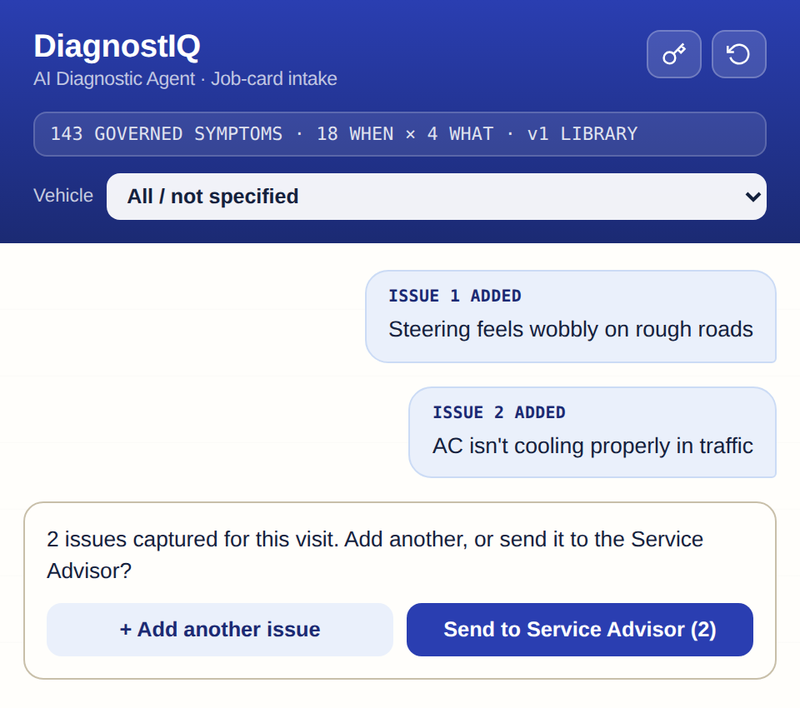
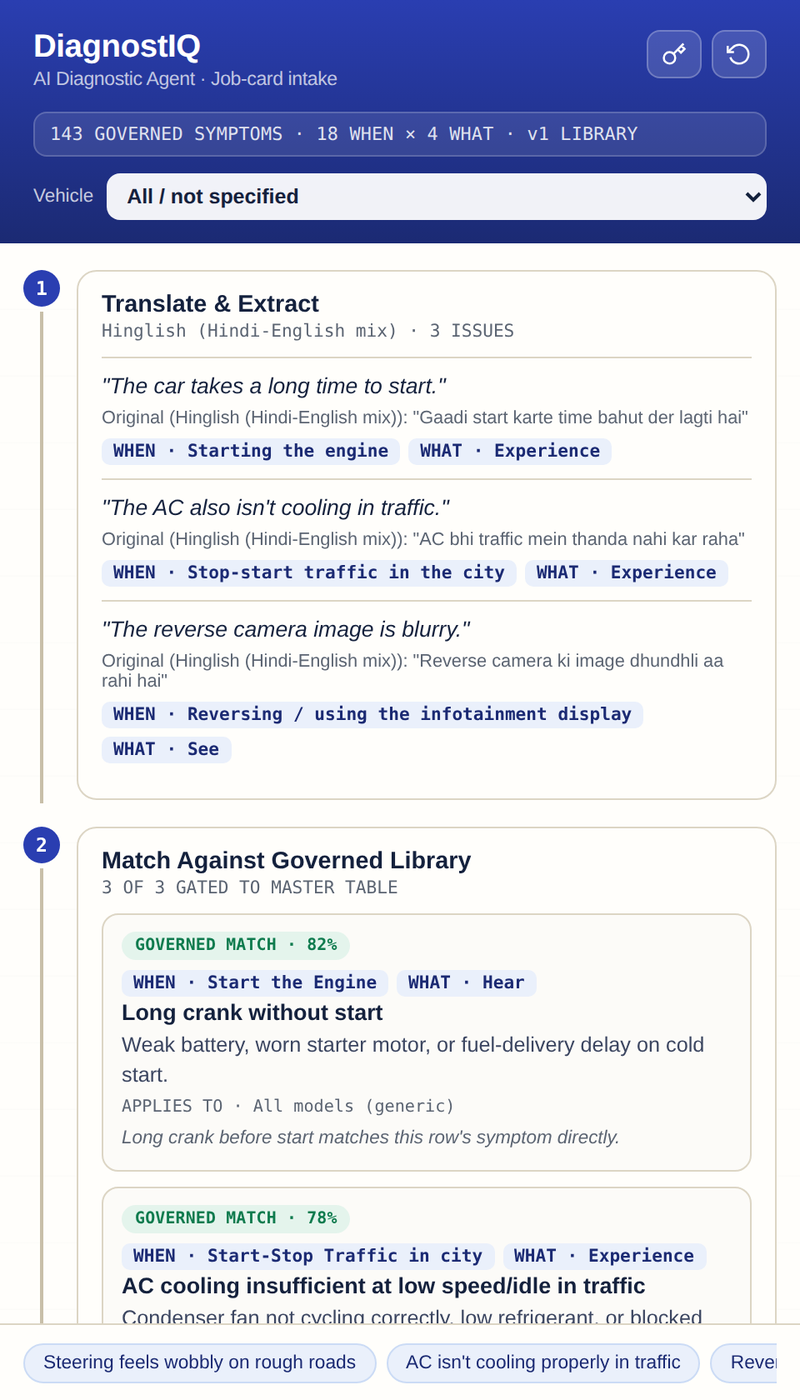
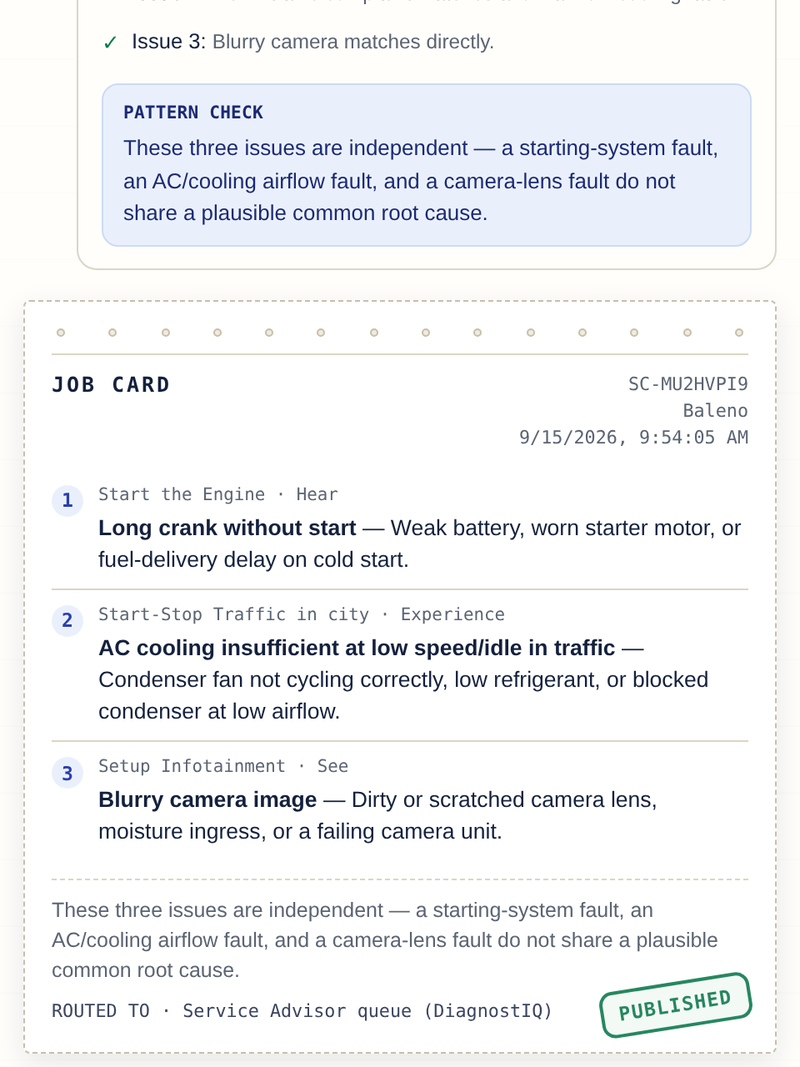
We are bridging that gap. We have built a working model and shown it to an OEM. The customer keeps speaking the way they always have, and the engineer receives exactly the inputs they need. Here is the workflow.

Screen showing a customer's two issues, typed in plain words: steering feels wobbly on rough roads, and the AC isn't cooling properly in traffic.
01The customer describes each issue in their own words, one at a time.
Screen showing issues written in a mix of Hindi and English being translated, then matched against an approved list of known causes.
02Their words are translated and matched against a fixed, approved list of known causes.
Screen showing a published job card listing three separate faults, routed to the service advisor.
03The result is checked and published as a clear job card for the service advisor.

We do not need a smarter engine. We need to listen to people the way they actually speak.

Good to know

How it works, in short.

Shared publicly

We publish our first thoughts so you can evaluate them freely, and so others can learn from them.

Your feedback, also public

Tell us what you think with a simple thumbs up or down, shown publicly alongside our thoughts.

Private by default

Your name and organisation stay out of it unless you choose otherwise. Nothing else about you is shared.

Dialogue is optional

If you like our thinking, we talk. That conversation is where a consulting project can begin. If you do not, you owe us nothing.

Time frame

We will confirm by email whether we can meet the time frame you choose.